9 Best Ergonomic Office Chair for Back Pain (November 2026)
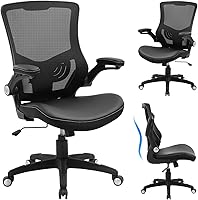
The best ergonomic office chairs for back pain include the BestOffice Ergonomic Office Chair for most home offices, the SIHOO M18 Ergonomic Office Chair for adjustable support, and the GABRYLLY Ergonomic Office Chair for flip-up arms and tall users.
On this page (8 sections)
- How we compared office chairs for back pain
- The best ergonomic office chair for back pain, chair by chair
- Which lumbar support type helps most people with back discomfort?
- What seat size and height should you choose?
- How much weight capacity and base strength do you need?
- How do you set up a chair for back support in 10 minutes?
- When should you add a cushion, pad or massage feature?
- Verdict: which chair should you buy?
The best ergonomic office chair for back pain overall is the BestOffice Ergonomic Office Chair, because it pairs breathable mesh and lumbar support with a height range that fits many desks.
The SIHOO M18 and GABRYLLY are close alternatives if you need a headrest, wider seat or flip-up arms.
Our score weighs specs, features and buyer feedback against what you are shopping for.
We have compared specs and features, and we do not test chairs.
Back chairs for bad backs work best when lumbar support lines up with your waist, seat height lets your feet rest flat, and the seat depth leaves a small gap behind your knees.
A chair that misses on fit can push you forward even if the lumbar pad looks strong.
Start with your height, weight and desk height before you look at extras.
Our ergonomic office chair buying guide breaks down fit checks you can do in a few minutes.
Our picks at a glance
-
1

-
2

-
3
 Best for flip-up arms and tall users
GABRYLLY Ergonomic Office Chair
9.5/10 our score
See it on Amazon
- 4
 Check it
Amazon Basics Office Task Chair with Adjustable
Best simple task chair - 5
 Check it
HOLLUDLE Ergonomic Mesh Office Chair
Best for 3D lumbar adjustment - 6
 Check it
Marsail Ergonomic Office Chair
Best for recline and arm position - 7
 Check it
TRALT Office Chair Ergonomic Desk Chair
Best for seat fit and foam - 8
 Check it
COLAMY High Back Executive Office Chair
Best padded executive style - 9
 Check it
Cloomey 500lbs Big and Tall Office Chair
Best for big and tall users
How we compared office chairs for back pain
We compared lumbar type, seat size, height range, capacity, back material and arm design across these 9 chairs.
We also checked which models suit long sitting, tall users, big and tall users and tight desk spaces.
Mesh backs dominate this group because they keep air moving during long sessions.
Padded options from Amazon Basics, COLAMY and Cloomey suit people who want a softer feel but trade airflow for cushioning.
Lumbar systems differ a lot.
Some use fixed curved padding, some move forward and back, and inflatable models let you tune pressure by air.
The right choice depends on where fixed support misses your spine.
Fit ranges also separate the group in practical ways.
Shorter users get a lower seat range on BestOffice, while taller users get headrests and wider backs on SIHOO, GABRYLLY and Marsail.
Capacity ranges from 250 lb on BestOffice to 500 lb on Cloomey, so weight and width should be checked together.
Assembly time ranges from about 10 minutes on BestOffice to 20 to 30 minutes on HOLLUDLE, which matters if you need the chair working the same day.
| Product | Best for | Seat height | Capacity | Back style | Our score |
|---|---|---|---|---|---|
| BestOffice Ergonomic Office Chair | most home offices | 17.1-20.3 in | 250 lb | Mesh back | 9.6 |
| SIHOO M18 Ergonomic Office Chair | adjustable support | 330 lb | Mesh back with headrest | 9.6 | |
| GABRYLLY Ergonomic Office Chair | flip-up arms and tall users | 300 lb | 9.5 | ||
| Amazon Basics Office Task Chair with Adjustable | simple task chair | 275 lb | Solid mid-back | 9.4 | |
| HOLLUDLE Ergonomic Mesh Office Chair | 3D lumbar adjustment | 350 lb | V-back mesh | 9.1 | |
| Marsail Ergonomic Office Chair | recline and arm position | 330 lb | High back mesh | 8.9 | |
| TRALT Office Chair Ergonomic Desk Chair | seat fit and foam | 17.7-21.7 in | 330 lb | 8.7 | |
| COLAMY High Back Executive Office Chair | padded executive style | 18.6-22.4 in | 300 lb | Padded high back | 8.4 |
| Cloomey 500lbs Big and Tall Office Chair | big and tall users | 500 lb | Continuous back | 8.3 |
The best ergonomic office chair for back pain, chair by chair
Every chair below targets lower-back support in daily use, but fit changes the winner.
Read for your height, weight, room temperature and desk snugness, not just the score order.
BestOffice Ergonomic Office Chair: Best for most home offices
- 100% ventilated mesh back
- Adjustable seat height 17.1-20.3 in
- Built-in lumbar support
- Supports up to 250 lb
- BIFMA standard materials
A mid-back mesh chair with lumbar support and adjustable height for daily work. It suits people who want airflow and simple setup.
Pros
- Breathable mesh keeps back cooler
- Adjustable height for desk fit
- Assembly in 10-15 minutes
Cons
- 250 lb cap is lower than big and tall picks
- Mid-back may not suit very tall users
BestOffice suits most home offices because its mid-back mesh, lumbar support and 17.1 to 20.3 inch height range cover many desk setups. It works best for adults who sit upright for concentrated work.
The 100 percent ventilated mesh back keeps air moving through long workblocks, so heat does not collect behind you on warm afternoons. Its high-density sponge cushion and curved mid-back design reduce fatigue during upright sitting.
The seat is 18 inches deep and 18 inches wide, so check thigh room if you prefer a wider base. Adjustable height and armrests plus a tilt tension knob let you set angle for focus or rest.
Set height first so your feet rest flat, then use tilt tension to slow or speed recline. Smooth swivel and rolling wheels help you reach files or a second screen without standing.
Trade-off is capacity and back height. It supports up to 250 lb and the mid-back frame may feel short for very tall users.
Choose it for airflow and assembly in 10 to 15 minutes, not for big and tall fit.
SIHOO M18 Ergonomic Office Chair: Best for adjustable support
- Adjustable headrest and lumbar support
- 2D armrests
- Tilt and recline functions
- Supports up to 330 lb
- Suitable for 5'6" to 6'2" users
Four support points and adjustable lumbar and headrest let you fine-tune fit. It suits taller users who need more adjustment than a basic task chair.
Pros
- Adjustable lumbar and headrest
- Wide cushion and 2D arms
- BIFMA tested
Cons
- Best fit starts at 5'6"
- More controls can take time to set up
SIHOO M18 suits taller users, about 5 feet 6 inches to 6 feet 2 inches, who want four support points at head, back, hip and hands. That height range makes it a better match than basic task chairs for longer torsos.
Adjustable seat height, headrest, lumbar and back support help you match the chair to your frame. You can move each point separately, which helps when your shoulders and waist do not align with a fixed curve.
The mesh backrest keeps airflow while you sit focused, and 2D armrests support forearms for typing and mouse work. The wide cushion spreads pressure under your thighs during long sessions.
Tilt and recline functions let you shift posture during calls or reading breaks. Small posture changes keep pressure from staying in one spot on your lower back.
It passed BIFMA testing and supports up to 150 kg, or 330 lb.
Trade-off is fit range and setup time. Shorter users under 5 feet 6 inches may struggle to get full support.
It also has more controls, so set lumbar first, then headrest, then arms, and give each setting a full work session.
GABRYLLY Ergonomic Office Chair: Best for flip-up arms and tall users
- High back with 3D headrest
- Flip-up arms
- 90-120 degree tilt lock
- Wide cushion 20.5 x 20 in
- Supports up to 300 lb
A wide high-back mesh chair with flip-up arms for tight desks. It suits people who work long hours and push the chair under the desk.
Pros
- Wide seat for different builds
- Flip-up arms save space
- 3D headrest adjustment
Cons
- Large footprint needs desk clearance
- Assembly about 15-20 minutes
GABRYLLY suits people about 5 feet 2 inches to 6 feet 1 inch who need a wide seat and space-saving arms. It is aimed at home offices where the chair must slide under a desk after work.
The seat measures 20.5 inches wide by 20 inches deep, with height from 18.9 to 23.6 inches. That width gives hips and thighs more room than narrower task seats.
Mesh back and mesh seat keep air circulating for 4 to 8 hour sitting, according to GABRYLLY. Airflow helps in warm rooms, though a mesh seat feels firmer than a padded cushion.
Flip-up arms rotate 45 degrees so you can push the chair under the desk, and the 90 to 120 degree tilt lock lets you recline while you read or take calls. Locking holds a reclined angle without sliding back.
A large 3D headrest adds support when you lean back. Adjust it so it touches your head without pushing your chin forward.
Trade-off is footprint. Overall width is 24.5 inches, so check desk clearance.
It supports up to 300 lb and carries a 3-year warranty for heavy daily use.
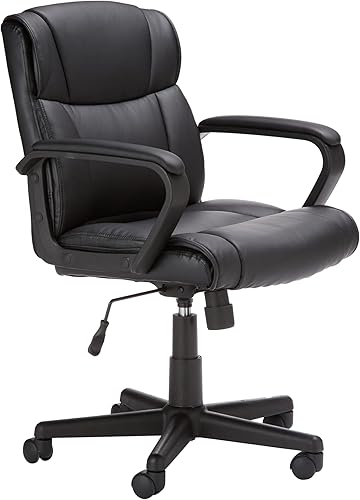
Amazon Basics Office Task Chair with Adjustable: Best simple task chair
- Mid-back faux leather
- Adjustable height and tilt
- 360 degree swivel
- 275 lb capacity
- Padded armrests
A straightforward padded task chair with height and tilt control. It suits conference rooms and short workblocks more than all-day mesh use.
Pros
- Simple controls for shared spaces
- Padded seat and arms
- Five-point base for stability
Cons
- Faux leather traps more heat than mesh
- Less lumbar adjustment than ergonomic picks
Amazon Basics suits shared offices, conference rooms and short task work where a simple padded chair is enough.
It is a practical pick when several people use the same seat for meetings or admin tasks.
Height-adjustable seat, adjustable seat angle, tilt control and 360 degree swivel cover basic movement.
Those controls let you face a desk, a table or a group without twisting your back.
Faux leather upholstery with padded seat, backrest and armrests gives a softer sit than mesh.
The surface wipes clean easily, which helps in shared or guest spaces.
Seat width is 20.1 inches and seat depth is 16.5 inches, with a 275 lb capacity and five-point base.
The shallower depth suits shorter users who need a gap behind the knees.
Caster wheels help on hard floors and low pile carpet.
Check your floor type, since casters can feel different on thick carpet.
Trade-off is heat and lumbar tuning.
Faux leather does not breathe like mesh, and lumbar support is not adjustable like the ergonomic picks.
Choose it for clean looks and simple controls, not for all-day back support.
HOLLUDLE Ergonomic Mesh Office Chair: Best for 3D lumbar adjustment
- 3D lumbar support up/down forward/back and rotate
- 2D headrest
- 3D armrests
- 3-level tilt lock
- 350 lb capacity
A V-back mesh chair with lumbar support you can move in several directions. It suits people who need precise lower-back positioning.
Pros
- Highly adjustable lumbar support
- 3D armrests and 2D headrest
- 5-year warranty
Cons
- V-back shape may feel different from curved backs
- Assembly 20-30 minutes
HOLLUDLE suits people who need lumbar support that moves in several directions. It is built for users who find fixed padding either too shallow or too deep for their spine.
Its 3D lumbar adjusts up, down, forward, backward and rotates, so you can place contact closer to your waist. That range helps when seat height changes where your lower back meets the chair.
The V-back mesh design adds a modern look, with a 2D headrest and 3D armrests for height, depth and rotation. Arm rotation can help if you type, use a mouse and reach for notes in one session.
A 3-level tilt lock helps you lock posture for work, gaming or relaxing. Use a firmer lock for typing and a looser angle for reading or watching video.
Broad mesh and high-density foam balance support and airflow. Mesh keeps heat from building up while the foam seat cushions your thighs.
Trade-off is back shape and setup time. The V shape may pressure shoulders differently than a curved back, and assembly takes 20 to 30 minutes.
It supports 350 lb and meets BIFMA and EN1335 standards, with a 5-year warranty.
Marsail Ergonomic Office Chair: Best for recline and arm position
- Adjustable lumbar 1.18 in forward/back and 2.16 in up/down
- 3D armrests
- 2D headrest
- 90-120 degree recline
- 330 lb capacity
A mesh chair with adjustable lumbar depth and height plus flip-up armrests. It suits people who switch between upright work and recline.
Pros
- Lumbar adjusts in two directions
- Thick foam seat
- Armrests flip up for desk access
Cons
- Heavier at 30.4 lb
- Many adjustments need checking before purchase
Marsail suits people who switch between upright work and recline during the day. It fits home offices where reading, calls and typing all happen in the same chair.
Backrest reclines from 90 to 120 degrees, with an adjustable 2D headrest to support head position. Head support is most useful when you lean back, not when you sit fully upright.
Lumbar support adjusts 1.18 inches forward and backward and 2.16 inches up and down, which helps match different heights and body shapes. That two direction movement lets you fine tune contact without buying a separate pillow.
The mesh back molds to your back while promoting airflow. Mesh tension feels supportive for many users, though it can feel firmer than padded leather.
Its 3.14 inch high-density foam seat and 330 lb capacity support long sessions. Thick foam spreads pressure, but check seat depth if you are shorter.
Armrests move forward, back and swivel, and flip up for closer desk access. Flipping helps in tight spaces or when you sit cross legged.
Trade-off is weight at 30.4 lb and many small adjustments to check before you buy, especially seat depth and arm reach if you are shorter.
TRALT Office Chair Ergonomic Desk Chair: Best for seat fit and foam
- Adjustable lumbar depth
- Breathable mesh back
- High-resilience molded foam seat
- Seat height 17.7-21.7 in
- 330 lb capacity
A mesh chair sized for users about 5'4" to 6'2" with a wide seat and adjustable lumbar. It suits people who prioritize seat depth and foam shape retention.
Pros
- Wide seat with thigh support
- Adjustable lumbar depth
- Class 3 BIFMA lift
Cons
- Seat depth can feel long for shorter users
- Mesh back width is narrower than some picks
TRALT suits users about 5 feet 4 inches to 6 feet 2 inches who care about seat depth and foam that holds shape. It is aimed at people who notice thigh pressure before back ache sets in.
The seat is 19.7 inches wide with 17.3 inch depth, leaving room for thighs while keeping a gap behind knees. That gap helps protect circulation when you sit for hours.
Lumbar support adjusts in depth to match your spine curve, and the breathable mesh back avoids heat buildup. Depth adjustment is useful if a fixed pad pushes your belly forward.
High-resilience molded foam is designed to resist flattening over time. Foam that holds shape keeps seat pressure more even across a workday.
Seat height from 17.7 to 21.7 inches helps feet stay flat at varied desk heights. Lower settings suit shorter users, while taller users can raise the seat for proper leg angle.
Trade-off is depth for shorter users and narrower back width at 13.4 inches. Shorter users should confirm the seat edge does not press behind the knees.
It supports 330 lb, with a Class 3 BIFMA lift for height stability. Assembly is about 15 minutes with no extra tools needed.
COLAMY High Back Executive Office Chair: Best padded executive style
- Inflatable lumbar airbag
- Flip-up padded arms
- High back with padded headrest
- Tilt lock 90-110 degrees
- 300 lb capacity
A padded leather executive chair with inflatable lumbar support you tune by air pressure. It suits people who want a softer, enclosed feel.
Pros
- Inflatable lumbar fills your gap
- Flip-up arms save space
- Padded headrest for neck support
Cons
- Padded back traps more heat than mesh
- Leather finish needs regular cleaning
COLAMY suits people who want a padded executive look with tunable lumbar pressure.
It is a better fit for cool rooms and users who prefer a softer first touch.
Its inflatable airbag lets you add air until support fills the gap between spine and chair.
Start with low pressure and add small amounts, since too much air can force an arch.
High back padding, padded headrest and flip-up arms give a softer, enclosed feel.
That enclosed feel can suit reading and video calls as well as typing.
Seat height runs 18.6 to 22.4 inches, with tilt from 90 to 110 degrees for upright work or rocking rest.
The range helps match standard desk heights without a footrest for many users.
Synchro tilt lets seat and back move together, which can feel more natural when you lean back.
Rocking can help you change posture during breaks from focused work.
Trade-off is heat and care.
Padded leather traps more heat than mesh and needs cleaning to resist stains and cracking.
It supports 300 lb on a sturdy nylon base, with assembly in about 20 minutes.
Cloomey 500lbs Big and Tall Office Chair: Best for big and tall users
- Inflatable lumbar support
- 500 lb capacity
- Extra wide seat
- Padded armrest cushions
- Heavy-duty metal base
A big and tall executive chair with inflatable lumbar and thick cushioning. It suits buyers who need capacity and width above standard task chairs.
Pros
- Highest capacity in this group
- Extra wide wraparound feel
- Upgraded rubber casters
Cons
- Large size needs more floor space
- Padded design is warmer than mesh
Cloomey suits big and tall adults who need width, cushioning and high capacity.
It is designed for users who find standard task chairs too narrow or too low in capacity.
It is rated to 500 lb, well above standard task chairs in this group.
That margin also gives more room to shift weight onto the arms during the day.
Inflatable lumbar support lets you tune lower-back pressure, while multi-layer thick cushioning wraps around hips and thighs.
Adjustable pressure helps fill the gap between your back and the chair without a separate pillow.
Padded armrest cushions add forearm support for long desk sessions.
Thick pads can reduce elbow pressure when you type or use a mouse.
Height adjustment helps you align seat level with your desk and keep feet flat.
Correct height keeps thighs level and helps lumbar support land at your waist.
Trade-off is size and warmth.
The continuous back and extra wide seat need more floor space, and padded upholstery breathes less than mesh.
Measure your room and desk clearance before you order this larger chair.
Upgraded rubber casters help on hardwood, laminate, tile and vinyl without marks.
Which lumbar support type helps most people with back discomfort?
Adjustable lumbar support helps most people because you can move it to your waist level and depth.
Fixed padding works only if your height and posture match the curve.
Inflatable lumbar, like COLAMY and Cloomey, lets you tune pressure gradually.
Start with low pressure, sit for 10 minutes, then add small pumps until contact feels even.
Mechanical lumbar, like HOLLUDLE and Marsail, gives repeatable positions you can return to after moving.
That helps if you share the chair or adjust often.
Fixed curved support, like BestOffice, is simpler and often enough for mid-back use.
If it pushes your belly forward, it sits too deep for your frame.
If you want more detail on depth and height, see our best adjustable lumbar support office chair guide.
For add-on support, our best lumbar support chair attachment page covers straps and pillows.
Best chairs for bad backs: fixed vs adjustable lumbar
Fixed lumbar suits people who sit in one posture and found a chair that already fits.
It needs less setup and fewer parts to loosen.
Adjustable lumbar suits tall, short and curvy users who miss fixed contact points.
It also helps when seat height changes your waist position.
Inflatable systems suit people who want fine pressure control.
They need a pump or valve check, and pressure can change with temperature.
Good chairs for bad backs: when a pillow helps
A best lumbar support chair pillow can fill a small gap on a chair you already own.
It works best when seat height and depth already fit.
Pillows shift during long sitting, so check position hourly.
If you move the pillow often, built-in adjustable lumbar may be a better long-term fit.
What seat size and height should you choose?
Choose seat height so feet rest flat and thighs stay roughly level.
Then check that seat depth leaves 2 to 4 fingers behind your knees.
BestOffice offers 17.1 to 20.3 inches, TRALT offers 17.7 to 21.7 inches, and GABRYLLY offers 18.9 to 23.6 inches.
Shorter users should favor the lower ranges.
Seat width matters for hips.
GABRYLLY at 20.5 inches and TRALT at 19.7 inches give more room than narrower task seats.
If you sit with one leg tucked or cross-legged, flip-up arms help.
GABRYLLY, Marsail and COLAMY let arms fold so you can slide under the desk.
For hip or tailbone pressure, see best office chairs for hip pain and best office chairs for tailbone pain.
A best chair cushions for tailbone pain cushion can also change seat pressure.
Mesh vs padded: which back is better for long hours?
Mesh suits warm rooms and 6 plus hour days because air flows through the back.
It also makes cleaning dust and spills simpler.
Padded leather suits cool rooms and people who prefer a softer first touch.
It can feel warm after long sitting and needs more surface care.
Our best office chairs with lumbar support roundup compares both styles side by side.
Seat depth checks for thigh pressure
Seat depth that is too long presses behind the knees and can cut circulation.
Seat depth that is too short leaves thighs unsupported and shifts weight to the tailbone.
Measure from the back of your knee to the back of your hip when seated.
Then leave a small gap between seat edge and knee when you compare product dimensions.
TRALT lists 17.3 inches deep, while Amazon Basics lists 16.5 inches deep.
That difference can matter for users over six feet tall.
How much weight capacity and base strength do you need?
Pick capacity above your weight with room to shift and lean.
Standard chairs here range from 250 lb to 350 lb, while Cloomey reaches 500 lb.
Capacity is not only about body weight.
Armrests, recline leverage and daily rolling stress the gas lift and base over time.
BIFMA standards appear on many picks here, including BestOffice, SIHOO, GABRYLLY, Amazon Basics and HOLLUDLE.
That signals tested strength, not a comfort guarantee.
Big and tall users should check seat width and base spread, not capacity alone.
Cloomey and GABRYLLY give wider seats for larger frames.
If you work mostly upright, tilt lock matters more than deep recline.
GABRYLLY locks from 90 to 120 degrees, while COLAMY locks from 90 to 110 degrees.
How do you set up a chair for back support in 10 minutes?
Set seat height first, then lumbar depth, then arm height.
Each step changes where your spine contacts the chair.
Sit with feet flat and knees near 90 degrees.
Raise or lower the seat until thighs feel level and pressure spreads under both thighs.
Move lumbar support to the curve above your belt line.
It should touch without pushing your chest forward or forcing a deep arch.
Set armrests so elbows bend near 90 degrees and shoulders stay down.
Then adjust headrest only if your head rests without pushing chin forward.
Use tilt lock for focused work and release it for breaks.
Our best office chair for back pain and long hours guide covers session length and break timing.
What about head, neck and shoulder support?
A headrest helps only if it supports without forward head push.
SIHOO, GABRYLLY, HOLLUDLE and Marsail offer adjustable headrests.
Check best office chairs for neck and shoulder pain if tension spreads upward.
A best adjustable headrest for office chair add-on can help on chairs without one.
A best neck pillow for chair can support brief rest, but it is not a substitute for correct seat height.
When should you add a cushion, pad or massage feature?
Add a cushion when seat foam bottoms out before your back feels tired.
That points to seat pressure, not lumbar position.
An best ergonomic office chair cushion can raise you slightly, so recheck desk height after adding it.
Too much lift can raise shoulders and change lumbar contact.
For heat or vibration, a best chair massage pads with heat or best massage pad for office chair may help you relax during breaks.
It will not fix poor seat depth or height.
If pain is sharp, spreads down a leg, or lasts more than a few weeks, talk with a doctor.
A chair should support posture, not diagnose or treat pain.
Verdict: which chair should you buy?
Buy BestOffice for most home offices, SIHOO M18 for taller users who want headrest and lumbar tuning, and Cloomey for big and tall capacity.
Each solves a different fit problem.
Choose GABRYLLY if flip-up arms and a wide seat matter more than compact footprint.
Choose HOLLUDLE or Marsail if lumbar position needs fine adjustment.
Choose TRALT if seat depth and foam shape are your top concerns.
Choose COLAMY if you want padded executive comfort and inflatable lumbar pressure.
Choose Amazon Basics for simple shared-space use or shorter workblocks.
For all-day sitting in a warm room, mesh picks will usually feel cooler.
Next, measure your desk height and compare it with seat height ranges above.
Then narrow to 2 chairs by lumbar type and seat width before you order.
Our top 3 picks at a glance
-
1
-
2
-
3
Best for flip-up arms and tall users
GABRYLLY Ergonomic Office Chair
9.5/10 our score
See it on Amazon
Frequently asked questions
How do I choose an ergonomic chair for back pain?
Start with lumbar position, seat height and seat depth. Your feet should sit flat, your knees near 90 degrees and lumbar support should contact your lower back without pushing you forward.
Adjust one setting at a time and sit for 20 minutes before changing it again.
Is mesh better than padded leather for back pain?
Mesh often suits warm rooms and long sitting because air flows through the back. Padded leather may feel softer at first but can trap heat.
Choose by room temperature, session length and whether you prefer firm mesh tension or padded cushioning.
What seat height is right for back support?
Set seat height so your feet rest flat and your thighs are roughly level. The BestOffice range is 17.1 to 20.3 inches, while TRALT offers 17.7 to 21.7 inches.
If your feet dangle, lower the seat or add a footrest and recheck lumbar contact.
How much weight capacity do I need?
Choose capacity above your body weight plus clothing and any load you shift onto the arms. Standard picks here range from 250 lb to 350 lb.
The Cloomey is rated to 500 lb for big and tall users who need more width and base strength.
Can adjustable lumbar support help lower back discomfort?
Adjustable lumbar may help by filling the curve of your lower back and reducing slouching. It does not treat a medical condition.
If pain persists, spreads to a leg, or limits daily activity, talk with a doctor or physical therapist.