Sihoo M18 or M57 Ergonomic Chair? (November 2026)
Choose the Sihoo M57 for more adjustment range, or the M18 for a simpler chair with a solid back and 2D armrests. Your height, posture changes and preferred support should decide the match.
On this page (8 sections)
- Sihoo M18 or M57: which chair has better adjustment?
- Which chair fits your back support needs?
- Does your height favor the M18 or M57?
- Which chair is better for reclined breaks?
- What are the M18 and M57 made for?
- Are there good alternatives to the M18 and M57?
- How should you set up either Sihoo chair?
- Sihoo M18 or M57 ergonomic chair: which should you choose?
Choose the Sihoo M57 for more adjustment range, or the M18 for simpler support with a solid back. This comparison focuses on fit, lumbar support, armrests, recline and how you sit each day.
The right choice depends on how you use a chair, not just how many controls it offers. Some people stay in one focused position for hours, while others shift between typing, reading, talking and resting.
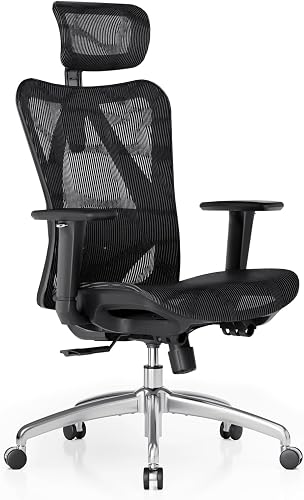
The M57 has 3D armrests, a split backrest and a 90° to 126° recline. The M18 has 2D armrests, a solid back and a stated fit range for users from 5 ft 6 in to 6 ft 2 in.
Both chairs have adjustable headrests, adjustable lumbar support, swivel movement and a 330 lb capacity. That shared capacity means weight limit alone will not decide this comparison for most buyers.
Think about your desk first, because a chair works as part of a setup rather than on its own. Seat height, arm position, screen distance and keyboard placement all affect whether an adjustment system feels useful.
The M57 suits people who change posture during the day and want separate control over neck, lower-back and arm support. That can help when a workday moves from focused typing to calls, reading or a more relaxed position.
The M18 suits people who want the main support areas in a more familiar office-chair layout. A solid back and 2D armrests may feel easier to set up and easier to reset after someone else uses the chair.
Neither chair is better in every room, because body proportions and desk height vary widely. Long sessions also reward small, repeatable changes rather than one perfect setting found at the start.
Regular cleaning and occasional checks of screws, casters and adjustment levers help keep any office chair steady and quiet. Use the sections that follow to compare height, back support, armrests and recline in daily use.

Sihoo M18 or M57: which chair has better adjustment?
The M57 has the wider adjustment range. It lets you adjust the headrest, move the lumbar support in height and depth, change the recline from 90° to 126° and use 3D armrests.
The M18 still covers the main adjustment points. Its headrest, lumbar support, seat height, back support and recline can be adjusted, while its armrests are 2D.
Choose the M57 when you often shift between typing, reading, calls and relaxed seating. More adjustment points can help you set the chair around different tasks.
Choose the M18 when you want the main support areas without as many armrest controls. A simpler control set can be easier to learn and repeat.
How do the M18 and M57 armrests compare?
The M57 has 3D armrests, while the M18 has 2D armrests. That difference matters most if your elbows and forearms need a more exact position beside your keyboard.
Set either chair so your shoulders can stay down while your hands reach the keyboard. Armrests that sit too high can lift the shoulders, while armrests that sit too low may leave the forearms unsupported.
For more guidance on desk posture and chair setup, read our ergonomic office chair buying guide. It explains how seat height, back support and arm position work together.
Which chair fits your back support needs?
Pick the M57 for a split backrest with moving lumbar support, or the M18 for a solid back with adjustable lumbar support. Neither choice is automatically right for every body.
The M57's lumbar support shifts in height and depth. Its split backrest is shaped around the spine, and its waterfall-edge seat is designed to support the thighs.
The M18 uses a solid back and provides adjustable lumbar support and back support adjustment. Its backrest is 20.47 in wide, compared with 20.07 in for the M57.
Those width figures are close, so the adjustment system may matter more than the small difference. If you want to fine-tune the lower-back position, the M57 has the clearer advantage.
If you want a conventional solid-back feel, the M18 may be easier to choose. Review the Sihoo M18 ergonomic office chair reviews for a closer look at its support layout.
Does your height favor the M18 or M57?
The M18 gives the clearer height guidance because it is described for users from 5 ft 6 in to 6 ft 2 in. The M57 data does not state an equivalent range.
That does not make the M57 unsuitable for other heights. It means you should check seat, headrest and lumbar positions more closely before choosing it.
For either chair, measure your desk and compare the seat position with your normal working posture. Your feet should rest securely, your knees should stay comfortable and your elbows should reach the desk without raised shoulders.
Height affects more than whether your feet reach the floor. It also changes where lumbar support meets your lower back and whether the headrest supports your neck without pushing your head forward.
A taller user may need the backrest and headrest higher, while a shorter user may need the seat lower and the armrests closer to the body. Those needs can conflict with a fixed desk height, so measure the desk before ordering.
Start with seat height by placing your feet flat and checking that your thighs are not pressed hard against the underside of the desk. If the chair must sit high to clear the desk, a footrest may help you keep stable support.
Check knee comfort without forcing a rigid right angle. Your legs should feel supported, your feet should not slide, and you should be able to shift without the seat edge digging into the backs of your legs.
The M57 headrest tilts and lifts, while the M18 also has an adjustable headrest. For taller users, a headrest that lifts can help when reclining or looking at a higher screen.
Lumbar position needs the same care. A support placed too high can push into the ribs, while one placed too low may miss the natural curve of the lower back.
On the M57, lumbar support shifts in height and depth for finer adjustment. On the M18, adjustable lumbar and back support still let you set the support around your lower back.
Armrest height also changes with body size. Set the armrests so your shoulders can stay relaxed while your hands reach the keyboard and mouse.
If armrests sit too high, your shoulders may rise and your neck may feel tense by the end of a long day. If they sit too low, your forearms may feel unsupported.
Measure your desk, note your usual footwear, and sit in your current chair before choosing. Those practical checks will tell you more about fit than height alone.
Which chair is better for reclined breaks?
The M57 is the clearer choice if you want a stated recline range from upright work to a 126° position. The M18 has tilt and an adjustable recliner, but its specifications do not give an angle range.
A 90° position on the M57 suits upright desk work. Moving toward 126° gives a more open posture for reading or a short break.
Recline should not replace a good desk setup. Keep the screen, keyboard and mouse close enough to avoid reaching forward, then use the backrest when you change tasks.
The value of recline depends on what you do while reclined. A position that suits reading may not suit typing, because upright work needs devices close enough to avoid leaning forward.
When you move toward a more open position, you may need to bring the keyboard or screen closer. Or you may shift to reading and media rather than active typing.
The M57 range of 90° to 126° gives a clear scale for comparing positions during the day. You can start upright for focused work, then open the backrest slightly for calls or reading.
Recline also changes where your head rests, so check the headrest after you change the back angle. A setting that feels right when upright may push your head forward or sit too low once you lean back.
Lumbar support needs a similar check after reclining. Adjust it in height and depth on the M57 if the support feels too strong or too weak in the new posture.
Short reclined breaks can help you change position during a long day, especially after sustained typing. Stand, stretch or walk after a break, since reclining is a posture change rather than a replacement for movement.
Locking the recline can make a position feel more predictable, but check the controls on either chair before assembly. Noise and movement matter in shared spaces, so test the recline and casters after setup.
Care for the recline mechanism is simple but important. Check bolts and adjustment parts periodically, and keep the recline area clear of items that could get caught.
If you want a chair built around longer reclined breaks, compare the Sihoo M57 ergonomic office chair review. For a broader set of brand options, see the best Sihoo ergonomic office chair guide.
Choose the M57 when a defined recline range is a priority and you expect to use several positions. Choose the M18 when tilt and an adjustable recliner are enough, and you prefer a simpler support layout.
What are the M18 and M57 made for?
The M57 is aimed at users who want a high-back mesh chair with detailed adjustments, while the M18 is aimed at users who want a breathable mesh chair with a more direct control layout.
The M57 has a reinforced aluminum base, a dual-frame backrest and quiet casters. Its product information gives a 330 lb capacity and a 16.5 kg item weight.
The M18 has a stainless steel frame, a solid back, a 14.3 kg item weight and a 330 lb capacity. It also uses a mesh backrest for airflow.
Both chairs are indoor office chairs with arms and swivel movement. The M57 has a black color, while the M18 is charcoal in its product title and black in its item highlight.
The M57 requires assembly. The M18 includes a user manual and is described as an 8-step assembly.
Follow the instructions for either chair and keep the hardware available until the frame and base are secure.
For mesh chair alternatives, our best ergonomic mesh office chair guide can help you compare different support layouts.
Are there good alternatives to the M18 and M57?
Choose the BestOffice chair for a smaller mid-back design, or the SIHOO B100 PRO for a footrest and deeper recline positions. These alternatives solve different seating needs rather than replacing the M18 and M57 in every setup.
The BestOffice chair has a 16.5 in backrest width and a dark black finish. Its curved mid-back design includes lumbar support, and its seat uses a high-density sponge cushion.
It suits a smaller workspace or anyone who prefers a mid-back chair. Its 250 lb capacity is lower than the 330 lb capacity of both Sihoo models, so compare that figure with your needs before choosing.
The SIHOO B100 PRO has a full-mesh back and seat, a wide headrest and a reinforced metal base. Its recline positions are 110°, 125° and 135°, so it is built for more relaxed seating than the M18 or M57 comparison alone.
Its 4D armrests can adjust, rotate or flip up. That may help if you want to move the armrests out of the way when pulling the chair under a desk.
The best armless office chair guide is another useful direction if your desk, table or work style makes armrests unnecessary. If you need a different Sihoo model, compare the options in the Sihoo ergonomic office chair guide.
How should you set up either Sihoo chair?
Start with seat height, then set the backrest, lumbar support, headrest and armrests in that order. Make small changes while sitting in your normal work position.
Place your feet on the floor and set the seat so your knees stay comfortable. Move the backrest until it supports your working posture without pushing your shoulders forward.
Adjust the M57's lumbar support in height and depth until it meets your lower back without forcing you away from the backrest. With the M18, position its adjustable lumbar support around the curve of your lower back.
Set the headrest only after the backrest is comfortable. It should support your neck during relaxed sitting without pushing your head forward while you type.
Finish with the armrests. Keep them low enough for relaxed shoulders and close enough to support your forearms without forcing your elbows outward.
Keep the desk and input devices within easy reach. Our ergonomic keyboard mouse guide covers the keyboard, mouse and tray choices that complete an ergonomic chair setup.
Sihoo M18 or M57 ergonomic chair: which should you choose?
Choose the Sihoo M57 if you want the most adjustment control, a defined 90° to 126° recline and lumbar support that moves in height and depth. Its 3D armrests and split backrest make it the stronger match for users who change posture often.
Choose the Sihoo M18 if you prefer a solid back, 2D armrests and a stated 5 ft 6 in to 6 ft 2 in fit range. It still provides adjustable headrest, lumbar and back support, plus the same 330 lb capacity.
The BestOffice chair makes more sense for a compact mid-back design with a 250 lb capacity. The SIHOO B100 PRO makes more sense if a retractable footrest, 4D flip-up armrests and 135° recline are more important than matching the M18 or M57 layout.
For the direct Sihoo choice, decide whether you value more adjustment points or a simpler support system. That is the clearest answer to the Sihoo M18 or M57 ergonomic chair question.
Frequently asked questions
Is the Sihoo M18 or M57 better?
The Sihoo M57 is better if you want more adjustment range, including 3D armrests, adjustable headrest and lumbar support, plus a 90° to 126° recline. The M18 is a better fit if you prefer a simpler design with 2D armrests and a solid back.
What is the main difference between the Sihoo M18 and M57?
The M57 offers 3D armrests, a split backrest, a 90° to 126° recline and lumbar support that shifts in height and depth. The M18 has 2D armrests, a solid back, adjustable lumbar support and a stated fit range of 5 ft 6 in to 6 ft 2 in.
Which Sihoo chair is better for long work hours?
Either can suit long desk sessions if its adjustments match your body and desk. The M57 gives you more ways to change arm, neck and lower-back support, while the M18 keeps the adjustment set simpler.
Set the seat, back and armrests so your shoulders stay relaxed.
Does the Sihoo M57 recline farther than the M18?
The M57 has a stated recline range from 90° to 126°. The M18 includes tilt and an adjustable recliner, but its available specifications do not state a matching angle range, so choose the M57 if a defined recline range matters.