8 Best Ergonomic Keyboard and Mouse Combos (November 2026)
The best ergonomic keyboard and mouse combos include the Logitech MK345 Full Size Wireless Keyboard for familiar full-size typing, the Logitech Wave Keys MK670 Wireless Ergonomic Keyboard for wavy keys and quiet clicks, and the ULSOU Wireless Keyboard And Mouse Combo for wave keys on a budget.
On this page (8 sections)
- How to choose the best ergonomic keyboard mouse combo for your desk
- How we compared these ergonomic keyboard and mouse combos
- Is a split ergonomic keyboard and mouse combo right for you?
- Which mouse shape fits your hand best?
- How do wireless range, receivers and batteries affect daily use?
- How much desk space does a combo really need?
- What about noise, backlighting and shortcut keys?
- Verdict: which ergonomic keyboard and mouse combo should you buy?
The best ergonomic keyboard and mouse combo for most desks is the Logitech MK345, because a full-size layout with a palm rest and a right-handed mouse feels familiar from day one. For more hand separation, our split ergonomic keyboard and mouse guide explains the learning curve before you choose a split model.
Our score weighs specs, features and buyer feedback against what you are shopping for. We compared key shape, mouse shape, connection type, battery type and desk footprint across all eight picks.
Our picks at a glance
-
1
 Best for familiar full-size typing
Logitech MK345 Full Size Wireless Keyboard
9.7/10 our score
See it on Amazon -
2
 Best for wavy keys and quiet clicks
Logitech Wave Keys MK670 Wireless Ergonomic Keyboard
9.5/10 our score
See it on Amazon -
3
 Best for wave keys on a budget
ULSOU Wireless Keyboard And Mouse Combo
9.4/10 our score
See it on Amazon
- 4
 Check it
SABLUTE Ergonomic Wireless Keyboard and Mouse Combo
Best for rechargeable backlit typing - 5
 Check it
RECCAZR Wireless Keyboard and Mouse Combo Silent
Best for quiet shared rooms - 6
 Check it
SABLUTE Ergonomic Wireless Keyboard and Mouse Combo
Best for shortcut-heavy office work - 7
 Check it
ProtoArc EKM01 Plus Wireless Ergonomic Keyboard Mouse
Best for split keys and 3 devices - 8
 Check it
MEETION Ergonomic Keyboard and Mouse Combo
Best for split keys and vertical mouse
How to choose the best ergonomic keyboard mouse combo for your desk
The right ergonomic mouse keyboard combo depends on hand size, desk depth and whether you want a familiar layout or a split one. Match the mouse to your hand first, then pick a keyboard shape you will keep using.
Start with our keyboards, mice and trays guide if you are new to ergonomic gear. It covers tray height, mouse placement and why a compact keyboard can bring the mouse closer.
Consider how long you type each day. Short sessions tolerate almost any shape, while full workdays expose wrist pressure, palm sweat and shoulder reach.
A palm rest that feels soft in a store can feel warm after six hours, so check the material and whether it can be wiped clean. Also consider whether you move between a desk and a standing frame.
Adjustable tilt legs matter more when height changes often, because a fixed slope can raise your shoulders at one height and flatten wrists at another. Sound matters too.
A quiet membrane suit shared rooms, while a crisper switch suit solitary desks where feedback helps focus.
Logitech MK345 Full Size Wireless Keyboard: Best for familiar full-size typing
- Full-size 104-key QWERTY layout
- Integrated palm rest
- 2.4 GHz wireless up to 10 m
- Keyboard battery up to 3 years
- Mouse battery up to 18 months
A familiar full-size keyboard with palm rest and a contoured right-handed mouse for steady office work.
Pros
- Familiar full-size layout with numeric pad
- Long battery life with included batteries
- Plug and play on Windows, macOS and ChromeOS
Cons
- Right-handed mouse only
- Full-size footprint needs desk space
The MK345 suits office workers who want a standard QWERTY layout with 104 keys and a numeric keypad. Its full-size keyboard with integrated palm rest keeps hands in a known position, which helps touch typists switch without retraining or hunting for keys.
The right-handed mouse has a contoured shape for all-day comfort and optical tracking for smooth scrolling through documents and web pages. Logitech rates the keyboard battery at up to 3 years and the mouse at 18 months, with two AA batteries included in the box for both devices.
Connection runs through a single USB-A Nano Receiver at up to 10 meters. It works with Windows 10 and later, macOS and ChromeOS, so setup is plug and play on most desktops and laptops without extra software.
Spill-resistant design and media keys add daily convenience for volume, mute and playback control. The trade-off is a full-size footprint that needs desk depth and a mouse made for the right hand only, with no split or vertical option.
Logitech Wave Keys MK670 Wireless Ergonomic Keyboard: Best for wavy keys and quiet clicks
- Wave-shaped compact keys
- Cushioned memory foam palm rest
- Signature M550 L mouse for medium to large hands
- Bluetooth and Logi Bolt
- SilentTouch mouse with 90 percent less click noise
Wave keys bring the mouse closer and a cushioned palm rest supports wrists during long typing days.
Pros
- Compact keyboard brings mouse closer
- Quiet mouse clicks
- Bluetooth plus USB receiver options
Cons
- No numeric keypad
- Mouse suits medium to large hands best
Wave Keys suits people who want natural hand position without a split keyboard. Its wave-shaped keys place hands, wrists and forearms in a natural typing position, and the compact 99-key size lets you bring the mouse closer to your body for a narrower shoulder stance.
The Signature M550 L mouse is ambidextrous and sized for medium to large hands. It has a contoured shape, rubber side grip and SmartWheel scrolling that moves line by line or flies through long web pages.
SilentTouch technology cuts click noise by 90 percent, according to Logitech. That helps in shared rooms and on calls where clicks carry through a microphone and distract others nearby.
You can connect by Bluetooth or the Logi Bolt receiver and use Easy-Switch to toggle between PC, tablet and phone across Windows, macOS, iPadOS and ChromeOS. The keyboard has up to 3 years of battery life and the mouse up to 2 years.
The trade-off is no numeric keypad and a mouse that may feel large for small hands. Fans of this style should also check our best ergonomic keyboard and mouse variations for wireless ranges.
ULSOU Wireless Keyboard And Mouse Combo: Best for wave keys on a budget
- Wave keys with wrist rest
- Adjustable stand
- 2.4 GHz up to 33 feet
- Auto power saving
- Windows and Mac layout switch with FN+Q or FN+W
Wave keys and an adjustable stand give a classic ergonomic shape without split-key learning.
Pros
- Adjustable stand for typing height
- Single receiver for both devices
- Wide Windows and Mac compatibility
Cons
- Batteries not included
- Receiver stored in mouse, easy to miss
ULSOU suits budget buyers who want wave keys and a wrist rest without extra cost. The keyboard has a wave key design that follows finger curve and an adjustable stand to set typing height for sitting or standing work.
The mouse is contoured for the right palm with forward and back buttons for web navigation. One 2.4 GHz receiver connects both devices up to 33 feet, with plug and play setup and no software download required.
Automatic power saving puts the keyboard to sleep after 30 seconds idle and the mouse after 15 minutes. Any button press wakes them, which helps preserve battery life across the two AA batteries, one per device.
It supports Windows XP through 11 and Mac, with FN+Q or FN+W to switch Windows and macOS layouts. Batteries are not included, so you need to buy AA cells separately.
The USB receiver sits on the back of the mouse, so check there first if the set will not pair. Against the others, it lacks Bluetooth switching and rechargeable power.
SABLUTE Ergonomic Wireless Keyboard and Mouse Combo: Best for rechargeable backlit typing
- 4000mAh rechargeable backlit keyboard
- Faux lambskin palm rest
- Wave keys
- 700mAh RGB mouse with 3 DPI levels
- 2.4 GHz up to 33 feet
A rechargeable backlit wave keyboard with a soft palm rest and a colorful mouse for low-light desks.
Pros
- Rechargeable keyboard, no disposable batteries
- Backlighting tones for low light
- Adjustable front and back stands
Cons
- Backlight uses more power than non-lit boards
- Mouse is right-handed
This SABLUTE combo suits people typing in low light who want a rechargeable keyboard. Its 4000mAh rechargeable battery lasts weeks on a charge, according to SABLUTE, and auto sleep helps conserve power between work sessions.
The faux lambskin palm rest is silky, sweat-proof and easy to clean compared with fabric that traps moisture. Wave keys support natural typing, and adjustable front and back stands help wrist posture at a standing desk or a raised table.
Backlighting offers soft tones like blue, cyan and white, plus bold colors like red, green, purple and yellow. Nine shortcut keys help with common tasks, and the keystroke rating is 10 million for long term use.
The RGB mouse has a 700mAh battery, 6 buttons and 3 DPI levels at 800, 1200 and 1600. One 2.4 GHz receiver connects both up to 33 feet, with USB-A and USB-C combo support.
The trade-off is higher power use from backlighting and a right-handed mouse, plus a heavier 1 kg keyboard.
RECCAZR Wireless Keyboard and Mouse Combo Silent: Best for quiet shared rooms
- Curved keys and silent membrane
- Silent mouse
- Front and back tilt legs
- 3 DPI levels 800/1200/1600
- Single nano USB receiver
Silent keys and a silent symmetrical mouse suit shared offices and late calls.
Pros
- Quiet keyboard and mouse
- Symmetrical mouse for left or right hand
- Double adjustable tilt legs
Cons
- Batteries not included
- Type-C adapter may be needed on some Macs
RECCAZR suits shared offices where noise matters. Its silent membrane keys and silent mouse keep typing and clicking low in volume.
Soft membrane keys also give a comfortable feel for long office hours.
Curved keys follow finger reach, and front and back tilt legs adjust typing angle for sitting or standing. The symmetrical mouse works for left-handed and right-handed users, which helps in shared desks and hot-desking setups.
The mouse offers 3 DPI levels at 800, 1200 and 1600 for different sensitivity needs. One nano USB receiver, stored under the mouse, connects both devices up to 33 feet without using a second port.
Compatibility covers Windows 2000 through 11, Mac OS, Chrome OS and Linux, with 9 shortcut keys for work and play. Batteries are not included, and some Mac setups need a Type-C adapter bought separately.
RECCAZR offers a 1-year warranty. Left-handed buyers may also compare our best left-handed ergonomic mouse picks for mouse-only options.
Against quieter rivals, it lacks Bluetooth and rechargeable power.
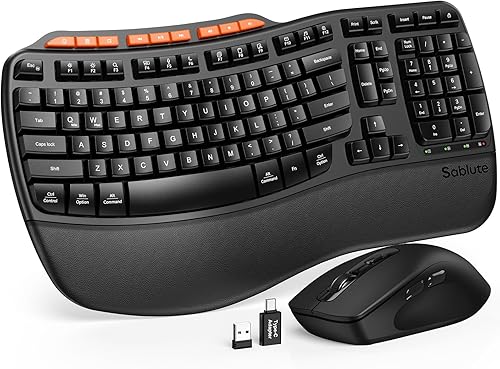
SABLUTE Ergonomic Wireless Keyboard and Mouse Combo: Best for shortcut-heavy office work
- Full size wave keys, 104 keys
- Leatherette wrist rest
- Front and rear tilt legs
- 9 shortcut keys
- 6-button mouse
Full-size wave keys with a leatherette rest and shortcut keys for email and spreadsheet days.
Pros
- Full-size layout with numeric pad
- Sweat-resistant wrist rest
- Shortcut keys cut repeated clicks
Cons
- Calculator and emoji shortcuts unavailable on macOS
- Heavier at 2.7 pounds
This SABLUTE model suits shortcut-heavy office work with a full-size layout. Its 104-key full-size wave keyboard keeps a numeric keypad for spreadsheets and data entry without moving to the mouse.
Wave-shaped keys follow the natural curve of your fingers to reduce awkward hand movement. A leatherette wrist rest is cushioned, sweat-resistant and easier to clean than fabric that absorbs oils over time.
Front and rear tilt legs let you adjust typing angle for sitting or standing desks. Nine shortcut keys cover emoji, screenshots, calculator and media controls, though calculator and emoji are unavailable on macOS.
The 6-button mouse pairs through stable 2.4 GHz wireless for navigation and browsing. A USB-A and USB-C adapter in the set helps with newer laptops that lack a full size USB port.
The trade-off is weight at 2.7 pounds and a right-handed mouse. Compared with the backlit SABLUTE model, this version uses AA batteries instead of a rechargeable cell.
ProtoArc EKM01 Plus Wireless Ergonomic Keyboard Mouse: Best for split keys and 3 devices
- Curved split keyframe, full size
- Memory foam palm rest
- Bluetooth and 2.4 GHz for 3 devices
- USB-C rechargeable
- 800/1300/2000 DPI mouse
A full-size split keyboard that switches across three devices and recharges over USB-C.
Pros
- Switches between 3 devices
- USB-C rechargeable keyboard and mouse
- Dedicated numeric keypad
Cons
- Large 20.75 x 11 in footprint
- Split layout takes adjustment time
ProtoArc suits readers who want split keys plus multi-device switching. Its curved split keyframe keeps wrists and forearms in a more natural position, with a cushioned memory foam palm rest and adjustable tilt legs for long workdays.
The sculpted mouse supports palm and thumb for a natural hand position. You can connect through 2.4 GHz USB or Bluetooth and switch between up to 3 devices, which helps when you move between a work computer, personal laptop and tablet.
Low-profile scissor-switch keys are responsive and quieter, with a dedicated numeric keypad for office tasks. DPI choices are 800, 1300 and 2000, plus forward and back buttons for browsing faster.
Both devices recharge via USB-C and use power-saving auto sleep. The keyboard measures 20.75 x 11 inches, so measure your desk first.
It is not backlit, and split layout may take an adaptation period. Against the MEETION, it offers Bluetooth switching but lacks a vertical mouse and side scrolling.
MEETION Ergonomic Keyboard and Mouse Combo: Best for split keys and vertical mouse
- Split keyboard, 112 keys
- Vertical mouse with 4 DPI levels
- Pillow wrist rest
- 500mAh rechargeable batteries
- 2.4 GHz within 33 feet
Split keys plus a vertical mouse change hand and wrist angles at the same time.
Pros
- Split halves can angle per hand
- Vertical mouse with side scroll
- Rechargeable with 1 to 2 months per charge
Cons
- Split layout needs learning time
- Typing is not silent
MEETION suits people who want both split keys and a vertical mouse. The keyboard splits into two halves so each hand can type at a comfortable angle, with a concave curve and angled keys for natural finger motion.
A pillowed wrist rest uses soft non-slip material for support. The keyboard measures 19.09 x 10.04 x 1.83 inches and has 112 keys in a full-size layout.
The vertical mouse changes wrist position during navigation, with DPI at 800, 1200, 1600 and 2400, a silent switch and side scrolling. Both share one USB-A receiver within 33 feet.
Each device has a 500mAh rechargeable battery, with 1 to 2 months per full charge. The USB-C port is an adapter that needs the USB-A receiver to work.
Typing feel is similar to a traditional retro keyboard, not silent, and split layout takes time to learn. For vertical-mouse fans, see our best ergonomic keyboard and vertical mouse combo guide.
Against ProtoArc, it lacks Bluetooth and a numeric pad advantage.
How we compared these ergonomic keyboard and mouse combos
We compared key shape, mouse shape, connection options and battery type across the eight picks. We checked desk footprint, hand orientation and operating system support in the product data.
We looked at whether the keyboard is full-size, compact, wave-shaped or split. We also checked mouse size, DPI options and whether left-handed users can use it.
Battery type matters for daily habits. Some sets use included AA batteries, some need batteries bought separately, and some recharge over USB-C.
What the specs do not tell you
Specs list key counts and DPI, but they do not show how a palm rest feels after a full day. We weighed materials in the data, such as memory foam, faux lambskin and leatherette, because cleaning and sweat resistance change daily use.
We also treated receiver placement as a practical point. A receiver stored inside a mouse is easy to lose, while a separate receiver is easier to keep with a laptop bag.
Finally, we checked whether shortcut keys work on macOS, because some functions listed for Windows do not transfer.
Is a split ergonomic keyboard and mouse combo right for you?
A split combo is right if you want hands separated and angled apart. It helps many typists keep wrists straighter and shoulders more relaxed during long sessions.
Split versus wave versus full-size layouts
Wave keys guide fingers along a curved row, but hands stay in one fixed width. Split keyboards let you set width and angle, which gives more freedom and more learning time.
Full-size boards like the MK345 keep a numeric keypad and familiar key positions. They suit data entry and fast touch typing with no adjustment period.
If split feels too different, a wave board is a softer step.
Who should try split first
Try split if you type all day and notice wrist or shoulder strain. Give yourself a week of practice before judging speed and accuracy.
ProtoArc and MEETION both warn about an adjustment period. That warning is normal for split boards, not a sign of poor quality.
Consider your desk first. A split board at 20 inches wide leaves less room for a mouse and a notebook.
Shallow desks can force the halves into a narrow angle that removes the benefit. Measure the width before you order, and check whether a tray or monitor riser would create extra space.
Laptop users should also test whether the split halves fit in a backpack or a slim bag. If you travel often, a compact wave board travels more easily than a wide split frame.
Which mouse shape fits your hand best?
Mouse shape matters as much as keyboard shape. A good ergonomic mouse and keyboard combo balances both, so your non-typing hand does not undo the keyboard gains.
Right-handed, ambidextrous and vertical mice
Right-handed mice like the MK345 and SABLUTE models support the palm and thumb on one side. Ambidextrous mice like the M550 L and RECCAZR symmetrical mouse suit shared desks and left-handed users.
Vertical mice, like the MEETION mouse, rotate the hand into a handshake position. That can suit wrist comfort for navigation-heavy days.
Hand size and DPI
Large hands often prefer the M550 L or a sculpted palm mouse. Small hands may find those mice bulky, so check mouse dimensions when they are listed.
DPI controls cursor speed. Office work often sits near 800 to 1200 DPI, while 1600 or higher suits faster movement on large monitors.
Our ergonomic mice for large hands guide helps if mouse fit is your main concern.
Mouse weight and grip also change comfort. A rubber side grip helps control a large mouse, while a smooth shell can slip when palms sweat.
Forward and back buttons shorten web navigation, but extra buttons add learning time for new users. If you switch between left and right hands, an ambidextrous shape avoids buying two mice.
Test palm contact by resting your hand without clicking. A good fit supports the palm without forcing fingers to stretch for the buttons.
How do wireless range, receivers and batteries affect daily use?
Most sets here use 2.4 GHz with a single USB receiver for both devices. That keeps one port free and keeps range to about 10 meters or 33 feet.
Bluetooth and multi-device switching
Bluetooth models like the Wave Keys MK670 and ProtoArc switch between computer, tablet and phone. That helps hybrid workers who move between systems.
Check whether the mouse uses the same connection as the keyboard. Some sets switch the keyboard only.
Rechargeable versus disposable batteries
Rechargeable sets remove battery swaps but need charging cables and time. The SABLUTE 4000mAh keyboard and MEETION 500mAh batteries are examples.
AA battery sets vary in life. Logitech rates the MK345 keyboard at up to 3 years, while others need batteries bought separately.
Check what is included before you order.
Receiver placement affects daily habits. A nano receiver kept in a laptop port can be forgotten in the end.
A receiver stored under a mouse needs opening the battery cover each time you move desks. Keep the receiver in a case if you move between home and office.
Also keep range in mind. A 10 meter rating suits a desk, but thick walls and metal desks can lower real range.
Place the receiver on the same side as the mouse when you can.
How much desk space does a combo really need?
Full-size keyboards with palm rests need more depth than compact boards. Measure desk depth, tray width and monitor stand clearance before ordering.
Compact keyboards and mouse position
Compact boards like Wave Keys bring the mouse closer to your body. That can help shoulder position compared with a wide full-size board.
Trays and standing desks
A keyboard tray can raise or lower typing height when desk height is fixed. Our best clamp-on keyboard tray guide covers that option for standing desks.
Split boards are wide, at 19 to 21 inches in this group. Leave room to angle the halves without pushing the mouse off the desk.
Depth matters as much as width. A palm rest adds several inches in front of the keys.
That depth can push the keyboard into your chair or pull your wrists forward. Short desks may need a tray or a riser to keep elbows near a right angle.
Check monitor height at the same time. A keyboard that is too low can tilt your head down, while a keyboard that is too high can lift your shoulders.
Measure from the desk surface to your elbows while seated.
What about noise, backlighting and shortcut keys?
Noise matters in shared rooms. Silent membrane keys and silent mouse switches, like the RECCAZR set, keep volume low during calls.
Backlighting for low-light work
Backlit keyboards like the SABLUTE 4000mAh model help in dim rooms. Backlighting drains battery faster, so rechargeable models handle it better.
Shortcut keys and office speed
Nine shortcut keys can speed email, screenshots and media controls. Check Mac compatibility, since some shortcuts differ by system.
Our best ergonomic keyboards for office work covers keyboard-only picks for numeric pad and key feel.
Backlight color is a personal choice, not a comfort feature. Soft white or blue tones suit reading, while bright colors can distract during video calls.
Check whether brightness can be lowered or turned off to save battery. Shortcut keys also need a short learning period.
A screenshot key saves time only if you remember it during a busy day. Media keys help during calls, but volume keys can trigger by accident if placed near typing keys.
Try the shortcuts for a week before deciding they help.
Verdict: which ergonomic keyboard and mouse combo should you buy?
Pick the Logitech MK345 if you want a familiar full-size layout with long battery life. Pick Wave Keys MK670 if you want wave keys, quiet clicks and Bluetooth switching.
Pick ProtoArc for split keys with 3-device switching, or MEETION if you want split keys plus a vertical mouse. Budget buyers should weigh ULSOU for wave keys and RECCAZR for silent use.
Measure your desk, match the mouse to your hand, and give split layouts a fair trial week. For wireless-only shortlists, our best wireless ergonomic keyboard and mouse guide narrows the field further.
If you type with a numeric keypad all day, stay with a full-size board. If you want a narrower desk, choose the compact Wave Keys.
If wrist angle is your main concern, split or vertical designs deserve a longer test. Return policies vary by seller, so check the terms before you commit to a layout that needs a week to learn.
Our top 3 picks at a glance
-
1
Best for familiar full-size typing
Logitech MK345 Full Size Wireless Keyboard
9.7/10 our score
See it on Amazon -
2
Best for wavy keys and quiet clicks
Logitech Wave Keys MK670 Wireless Ergonomic Keyboard
9.5/10 our score
See it on Amazon -
3
Best for wave keys on a budget
ULSOU Wireless Keyboard And Mouse Combo
9.4/10 our score
See it on Amazon
Frequently asked questions
What is the best ergonomic keyboard and mouse combo?
For most people, the Logitech MK345 is the easiest starting point. Its full-size layout and palm rest feel familiar, and the right-handed mouse fits all-day use.
If you want split keys or a vertical mouse, the ProtoArc and MEETION change hand position more.
Is a split ergonomic keyboard and mouse combo better?
A split layout lets each hand sit at its own angle and width. That can suit wrist and shoulder comfort, but touch typists often need a few days to adjust.
Choose split if you want more hand separation, not just a curved key row.
What should I check before buying a combo?
Check keyboard width, mouse hand size, receiver type and battery type first. Measure your desk depth and tray space, then confirm whether you need a numeric keypad.
Also check Mac or Windows layout switching if you use two systems.