9 Best VIVO Monitor Mounts for Standing Desks (November 2026)
The best VIVO standing desk monitor mounts include the VIVO Dual Monitor Desk Mount for dual screens on a clamped desk, the HUANUO FlowLift Dual Monitor Stand for gaming dual screens, and the VIVO Single Monitor Desk Stand for a freestanding single screen.
On this page (10 sections)
- VIVO and HUANUO mounts for standing desks, by screen setup
- Best VIVO standing desk monitor mount: comparison table
- How we compared these mounts
- Which VIVO mount fits a standing desk in 2026?
- What screens do these mounts actually fit?
- How much adjustment do you need for sitting and standing?
- Dual arm, single arm or stacked stand?
- What about reach and desk depth?
- How do cables work on a moving desk?
- Verdict: which VIVO mount should you buy?
The best vivo standing desk monitor mount for most dual monitor desks is the VIVO Dual Monitor Desk Mount STAND-V002. It holds two screens to 30 in and 22 lb each, and it clamps or grommets to desks to 3.25 in thick.
Our score weighs specs, features and buyer feedback against what you're shopping for. We compared screen size, weight limits, desk thickness, pole height, tilt range and cable control across all 9 picks.
Start with your screen count. Two regular screens suit a dual arm.
One ultrawide suits a single arm rated to 38 in. Two ultrawides stacked suit a vertical stand.
If you have not chosen a desk yet, our How to Choose a Standing Desk: A Simple Guide covers desktop size and clamp clearance first. A mount needs a clear back edge and enough depth for the clamp.
Our picks at a glance
-
1

-
2

-
3
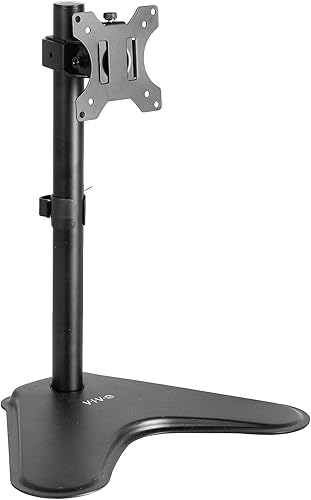 Best for a freestanding single screen
VIVO Single Monitor Desk Stand
9.6/10 our score
See it on Amazon
- 4
 Check it
VIVO Single 13 to 38 inch Ultrawide
Best for a single ultrawide on a clamp - 5
 Check it
VIVO Dual Monitor Desk Stand Free-Standing LCD
Best for stacked vertical screens - 6
 Check it
VIVO Extra Tall Single Monitor Desk Mount
Best for sit to stand height range - 7
 Best for heavier single screensCheck it
- 8
 Check it
VIVO Extra Tall Single Monitor Desk Mount
Best for a tall pole in white - 9
 Check it
VIVO Freestanding Dual Monitor Stand with Sleek
Best for dual screens without a clamp
VIVO and HUANUO mounts for standing desks, by screen setup
The top pick suits the most common dual screen desk. The other picks cover single ultrawides, stacked screens, tall sit to stand poles and freestanding bases.
VIVO Dual Monitor Desk Mount: Best for dual screens on a clamped desk
- Holds 2 screens 13 to 30 in, up to 22 lb each
- VESA 75x75mm or 100x100mm
- C-clamp or grommet mount for desks up to 3.25 in
- Tilt, swivel and rotation
- Cable clips on arms and center pole
A heavy duty steel dual arm for two regular screens, with full tilt, swivel and rotation and cable clips along the arms.
Pros
- Two screens up to 30 in
- C-clamp and grommet options
- Cable clips included
Cons
- Not for ultrawides over 30 in
- Desk must be 3.25 in thick or less for clamp
This dual arm suits buyers with two regular screens to 30 in on a desk they can clamp. Each arm holds to 22 lb, so check the weight of both screens plus any adapters.
The C-clamp fits desks to 3.25 in thick, and a grommet mount is included for desks with a cable hole. That choice matters on a standing desk, because a grommet hole may sit in a fixed spot as the desk moves.
Tilt runs plus 90 to minus 90 degrees, swivel is 180 degrees and rotation is 360 degrees. You can run both screens in landscape, or rotate one to portrait for documents.
Cable clips run along the arms and center pole. Route cables before you tighten the arms, so the clips hold the cords without pulling on the ports.
Trade-off: it stops at 30 in, so wide ultrawides need a single arm or a stacked stand. Against the HUANUO dual arm, this one allows lighter screens and a simpler clamp.
HUANUO FlowLift Dual Monitor Stand: Best for gaming dual screens
- Holds 2 screens 13 to 32 in, 4.4 to 19.8 lb each
- VESA 75x75mm or 100x100mm
- C-clamp or grommet for 0.59 to 3.54 in desks
- Height adjustment to 15.75 in
- Tilt, swivel and 360 rotation
A dual arm with a larger clamp platform and height adjustment to 15.75 in, for screens from 13 to 32 in.
Pros
- Screens to 32 in
- Dual C-clamp structure
- Height to 15.75 in
Cons
- Each screen must be at least 4.4 lb
- Wooden desks only, no plastic or glass
This HUANUO dual arm suits gamers and workers with two screens to 32 in. Each screen must weigh 4.4 to 19.8 lb, so very light screens can fall below the range.
The dual C-clamp uses a larger platform to lock the arm to the desk. It also offers a grommet option for desks from 0.59 to 3.54 in thick.
Height adjustment raises the screens to 15.75 in. That helps you set eye level for standing work without stacking books under the monitors.
Tilt is plus 85 to minus 50 degrees, swivel is plus or minus 90 degrees and rotation is 360 degrees. You can pull a screen closer for detail work or push it back for video.
Trade-off: HUANUO recommends wooden desks only, and plastic or glass desks are not suitable. The desk also needs no cross beams or panels under the clamp area.
Against the VIVO dual arm, this one takes larger screens but has stricter desk and weight rules.
VIVO Single Monitor Desk Stand: Best for a freestanding single screen
- Holds 13 to 32 in screens and ultrawides to 38 in
- Up to 22 lb, VESA 75x75mm or 100x100mm
- Freestanding base, no clamp
- Tilt, swivel, rotation and height adjustment
- Cable management
A freestanding single stand for regular screens to 32 in and ultrawides to 38 in, with no desk clamp needed.
Pros
- No clamp or drilling
- Ultrawide to 38 in
- Portrait or landscape
Cons
- Takes desk space for the base
- Tilt range is only plus or minus 15 degrees
This freestanding single stand suits a single screen user who cannot or will not clamp to the desk. It fits screens from 13 to 32 in and ultrawides to 38 in, to 22 lb.
The open top slot VESA plate slides onto the stand for easy mounting. You can also place the screen in portrait or landscape.
Tilt is plus 15 to minus 15 degrees, swivel is 90 degrees and rotation is 360 degrees. Height adjusts along the center pole to bring the top of the screen near eye level.
Integrated cable management keeps cords tidy as you move the screen. That helps on a standing desk where cables must flex as the desk rises and falls.
Trade-off: the base takes desktop space and cannot be moved to the back edge like a clamp. Tilt range is narrow, so set the height well and use the swivel for shared viewing.
VIVO Single 13 to 38 inch Ultrawide: Best for a single ultrawide on a clamp
- Holds 13 to 32 in screens and ultrawides to 38 in
- Up to 22 lb, VESA 75x75mm or 100x100mm
- C-clamp or grommet for desks up to 3.25 in
- Height adjustment to 16 in
- Full tilt, swivel and rotation
A single clamped arm for ultrawides to 38 in, with height adjustment to 16 in and full articulation.
Pros
- Ultrawide to 38 in
- Height to 16 in
- Cable clips included
Cons
- Single screen only
- Desk up to 3.25 in for clamp
This single clamped arm suits one ultrawide to 38 in or one regular screen to 32 in. It holds to 22 lb with VESA 75x75mm or 100x100mm holes.
The height adjusts to 16 in along the pole. That gives you more range than the freestanding single stand for standing eye level.
Tilt runs plus 90 to minus 90 degrees, swivel is 360 degrees and rotation is 360 degrees. You can turn the screen to portrait for code or long documents.
The C-clamp fits desks to 3.25 in thick with hand tightening, and a grommet mount is included. Cable clips on the arm and pole keep power and video cords in line.
Trade-off: it is a single arm, so two screens need two arms or a dual mount. For two screens, our dual monitor arm vs two single arms guide compares cost, reach and cable routing.
VIVO Dual Monitor Desk Stand Free-Standing LCD: Best for stacked vertical screens
- Holds 2 ultrawide screens 13 to 34 in in stacked position
- Up to 22 lb each, VESA 75x75mm or 100x100mm
- Freestanding base 15.4 x 12.4 in
- Tilt, swivel, rotation and height adjustment
- Cable management
A freestanding stand that stacks two ultrawides to 34 in vertically, on a 15.4 x 12.4 in padded base.
Pros
- Two ultrawides stacked
- No clamp needed
- Padded base protects desk
Cons
- Stacked layout only
- Base takes desk space
This freestanding stand suits buyers who want two ultrawides without using the back edge of the desk. It stacks two screens from 13 to 34 in, to 22 lb each, in a vertical position.
The base measures 15.4 x 12.4 in and has padding on the bottom to protect the desktop. That footprint is the main space cost to plan for.
Brackets offer plus 45 to minus 45 degrees tilt, 360 degrees swivel and 360 degrees rotation. Height adjusts along the center pole, and both screens can run in portrait or landscape.
Integrated cable management keeps cords organized behind the pole. Removable VESA plates make screen changes simpler.
Trade-off: stacked screens suit some workflows and annoy others, especially if you look up often. It also takes more desk depth than a clamp.
For side by side dual screens, the clamped dual arms give a wider view.
VIVO Extra Tall Single Monitor Desk Mount: Best for sit to stand height range
- 39 in pole for sit and stand use
- Holds 13 to 32 in screens and ultrawides to 38 in
- Up to 22 lb, VESA 75x75mm or 100x100mm
- C-clamp or grommet for surfaces to 4 in
- Full tilt, swivel and rotation
A single arm on a 39 in pole, so one screen can follow you from sitting height to standing height.
Pros
- 39 in pole
- Clamp to 4 in thick surfaces
- Ultrawide to 38 in
Cons
- Single screen only
- Tall pole needs clearance above desk
This extra tall single arm suits a standing desk user who wants one screen to follow from sitting to standing. The 39 in center pole gives that height range on a single arm.
It fits screens from 13 to 32 in and ultrawides to 38 in, to 22 lb, with VESA 75x75mm or 100x100mm holes. Tilt is plus 90 to minus 90 degrees, swivel is 360 degrees and rotation is 360 degrees.
The C-clamp fits surfaces to 4 in thick, which is more than most picks here. A grommet mount is also included.
Cable clips run along the arm and pole.
Trade-off: the tall pole needs clear space above the desk and can look large on a small desktop. It is also a single arm, so dual screens need a second mount or a dual model.
For more tall options, our extra long monitor arm guide compares pole height and reach. Check your desk depth before you order, so the clamp and screen do not crowd your keyboard.
HUANUO Monitor Stand: Best for heavier single screens
- Holds 13 to 34 in screens to 44 lb
- VESA 75x75mm or 100x100mm
- Freestanding steel column and tempered glass base
- 5 height options, 9.27 to 15.26 in
- Swivel, tilt and 360 rotation
A freestanding stand for screens to 34 in and to 44 lb, with 5 height settings and a glass base.
Pros
- 44 lb capacity
- No drilling
- 5 height settings
Cons
- Single screen only
- Tilt range is plus 10 to minus 15 degrees
This freestanding HUANUO stand suits a single heavier screen to 34 in. It holds to 44 lb, which is more than the VIVO single stands here.
The steel column is 17.24 in tall, with a tempered glass base and anti-slip pads. There are 5 height settings from 9.27 to 15.26 in.
Swivel is plus or minus 50 degrees, tilt is plus 10 to minus 15 degrees and rotation is 360 degrees. You can switch between landscape and portrait, though off-center VESA patterns may affect vertical use.
No drilling is needed, and two cable clips route cords along the back of the pillar. That makes it simple for a rental or a glass desk where a clamp will not work.
Trade-off: the height range is shorter than the tall VIVO poles, so it may not reach standing eye level for taller users. It is also a single screen stand, not a dual arm.
VIVO Extra Tall Single Monitor Desk Mount: Best for a tall pole in white
- 39 in pole, 99.1 cm
- Holds 13 to 32 in screens and ultrawides to 38 in
- Up to 10 kg, VESA 75x75mm or 100x100mm
- C-clamp or grommet for desks to 10.2 cm
- Full tilt, swivel and rotation
A white version of the extra tall single arm, with a 39 in pole and clamp or grommet mounting.
Pros
- 39 in pole
- White finish option
- Cable clips included
Cons
- Single screen only
- Same reach limits as the black tall model
This white extra tall single arm suits the same sit to stand use as the black tall model, in a white finish. The 39 in pole lets one screen move from sitting to standing height.
It fits screens from 13 to 32 in and ultrawides to 38 in, to 10 kg, with VESA 75x75mm or 100x100mm holes. Tilt is plus 90 to minus 90 degrees, swivel is 360 degrees and rotation is 360 degrees.
The C-clamp fits desks to 10.2 cm thick, and a grommet mount is included. Cable clips along the arm and pole keep cords tidy.
Trade-off: it is a single arm, so it does not solve dual screen setups. The tall pole also needs clearance above the desk and a desk deep enough for the clamp.
Choose the white finish for a light colored desk, or the black finish for a darker setup. The specs and limits are otherwise closely matched.
VIVO Freestanding Dual Monitor Stand with Sleek: Best for dual screens without a clamp
- Holds 2 screens 13 to 32 in, to 22 lb each
- VESA 75x75mm or 100x100mm
- Tempered glass base 15.2 x 10.2 in
- Tilt, swivel, rotation and height adjustment
- Removable VESA plates
A freestanding dual stand on a tempered glass base, for two screens to 32 in with no desk clamp.
Pros
- No clamp needed
- Glass base 15.2 x 10.2 in
- Portrait or landscape
Cons
- Base takes desk space
- Do not pull screens far forward without bolting down
This freestanding dual stand suits buyers who want two screens without a desk clamp. It holds two screens from 13 to 32 in, to 22 lb each, with VESA 75x75mm or 100x100mm holes.
The tempered glass base measures 15.2 x 10.2 in and has bottom padding. The pole and arms are steel, with removable VESA plates for easy mounting.
Arms offer plus 90 to minus 90 degrees tilt, 360 degrees swivel and 360 degrees rotation. Height adjusts along the center pole, and both screens can run in portrait or landscape.
Trade-off: the base takes desk space, and VIVO warns not to pull monitors too far forward or backward unless the stand is bolted down. That limits how far you can reach the screens.
For a clamped dual arm that frees the desktop, compare the VIVO dual mount and the HUANUO dual arm above. For a freestanding dual stand, this one is the simpler choice.
Best VIVO standing desk monitor mount: comparison table
The table shows the main limits that matter first: screen size, weight, mounting type and desk thickness. Use it to rule out models that do not fit your screens.
| Product | Best for | Screen size | Weight limit | Mount | Our score |
|---|---|---|---|---|---|
| VIVO Dual Monitor Desk Mount | dual screens on a clamped desk | 13 to 30 in | 22 lb each | C-clamp or grommet | 9.7 |
| HUANUO FlowLift Dual Monitor Stand | gaming dual screens | 13 to 32 in | 4.4 to 19.8 lb each | C-clamp or grommet | 9.7 |
| VIVO Single Monitor Desk Stand | a freestanding single screen | 13 to 32 in, ultrawide to 38 in | 22 lb | Freestanding | 9.6 |
| VIVO Single 13 to 38 inch Ultrawide | a single ultrawide on a clamp | 13 to 32 in, ultrawide to 38 in | 22 lb | C-clamp or grommet | 9.5 |
| VIVO Dual Monitor Desk Stand Free-Standing LCD | stacked vertical screens | 13 to 34 in stacked | 22 lb each | Freestanding | 9.2 |
| VIVO Extra Tall Single Monitor Desk Mount | sit to stand height range | 13 to 32 in, ultrawide to 38 in | 22 lb | C-clamp or grommet | 8.9 |
| HUANUO Monitor Stand | heavier single screens | 13 to 34 in | 44 lb | Freestanding | 8.7 |
| VIVO Extra Tall Single Monitor Desk Mount | a tall pole in white | 13 to 32 in, ultrawide to 38 in | 10 kg | C-clamp or grommet | 8.4 |
| VIVO Freestanding Dual Monitor Stand with Sleek | dual screens without a clamp | 13 to 32 in | 22 lb each | Freestanding | 8.2 |
How we compared these mounts
We checked screen size, weight limits, VESA patterns, desk thickness, pole height and tilt ranges from the product data. We ruled out any mount where the screen size or weight limit did not match the model.
We gave more weight to mounts that fit standing desks well. That means a clamp or grommet that fits common desk thickness, a pole tall enough for standing eye level, and cable clips that keep cords clear as the desk moves.
Our score weighs specs, features and buyer feedback against what you're shopping for. Higher scores go to mounts with wider screen ranges, safer weight limits and more flexible adjustment.
We did not test these mounts hands on. Claims about stability and comfort come from the brands and from buyer patterns we reviewed.
Which VIVO mount fits a standing desk in 2026?
A VIVO mount fits a standing desk if the clamp fits your desktop thickness, the pole reaches your standing eye level, and the cables can flex as the desk moves. Check all three before you compare tilt range.
Desk thickness is the first limit. Most clamped picks here fit to 3.25 in, the tall black arm fits to 4 in, and the HUANUO dual arm fits to 3.54 in.
Measure your desktop first.
Pole height is the second limit. A 16 in pole suits a fixed height or a modest sit to stand range.
A 39 in pole suits a fuller range from sitting to standing.
Cable routing is the third limit. Clips on the arm and pole help, but leave slack behind the desk.
A tight cable will pull on the monitor ports as the desk rises.
If you need desk size help first, read How Much Space Do I Need for a Standing Desk? before you buy a mount. A small desktop may not fit a freestanding base or a dual arm.
Clamp, grommet or freestanding base?
A clamp grips the back edge and keeps the desktop clear. It suits wooden desks within the stated thickness range.
A grommet mount uses a cable hole in the desk. Check that the hole position leaves room for the arm to swing without hitting the wall.
A freestanding base sits on the desk and needs no clamp. It suits glass desks, rentals and desks with a back panel or cross beam.
HUANUO states its dual arm is for wooden desks only. Do not use it on plastic or glass, even if the thickness fits.
What screens do these mounts actually fit?
Screen size alone does not tell you if a mount will fit. You must check size, weight and VESA pattern at the same time.
Most picks here fit screens from 13 in. Regular screen limits are 30, 32 or 34 in, depending on the model.
Ultrawide limits go to 38 in on the single arms.
Weight limits are 22 lb on most VIVO picks, 19.8 lb per screen on the HUANUO dual arm, and 44 lb on the HUANUO freestanding stand. Weigh your screen if you are close to the limit.
VESA patterns are 75x75mm or 100x100mm on every pick here. If your screen uses a different pattern, you may need an adapter that the brand approves for that load.
Ultrawide screens need a different check
An ultrawide is wider than a regular screen of the same diagonal. The arm must reach far enough that the screen does not hit the pole or the wall.
The single VIVO arms rate ultrawides to 38 in. The stacked VIVO stand rates two ultrawides to 34 in.
The HUANUO freestanding stand rates screens to 34 in, not 38 in.
Check the width of your screen, not just the diagonal. A wide screen on a short arm can crowd the desk even if the weight limit fits.
How much adjustment do you need for sitting and standing?
Height adjustment matters more than tilt for a standing desk. You need the top of the screen near eye level at both sitting and standing heights.
A short pole or a fixed height stand may work for sitting only. The 39 in pole arms give the widest range for sit to stand use.
Tilt helps you reduce glare and set the viewing angle. Most clamped arms give plus 90 to minus 90 degrees, while freestanding stands give a narrower range.
Swivel and rotation help for shared viewing and portrait work. Rotation to portrait suits code, documents and chat panels.
Set the height before you set the tilt
Set the screen height first, then add tilt. A screen that is too low will force you to look down, even with full tilt range.
Put the top of the screen at or just below eye level. Your eyes should meet the screen without tipping your head.
Test both sitting and standing positions. A height that works seated may be too low when you stand.
Dual arm, single arm or stacked stand?
A dual arm holds two screens side by side on one pole. It suits spreadsheets, video timelines and side by side documents.
Two single arms give more freedom to place each screen. They cost more in desk space and cable routing, but each arm moves on its own.
A stacked stand holds two screens one above the other. It saves width but can force a longer look up and down.
Our best dual monitor arms for standing desk guide compares dual arms in more detail. Read it if you plan two side by side screens.
When two single arms beat one dual arm
Two single arms suit mismatched screens or a very wide desk. Each arm can sit at its own height and angle.
Two single arms also help if one screen is an ultrawide and the other is a small portrait screen. A dual arm may force them to share one pole height.
The cost is more clamps, more cables and more setup time. Plan the cable path for both arms before you drill or clamp.
What about reach and desk depth?
Reach is how far the screen can sit from the pole. A short arm can push a large screen too close to your body on a shallow desk.
Check your desk depth before you buy. A dual arm needs room for two screens, the pole, the clamp and your keyboard.
Our monitor arm mount guide explains reach, clamp fit and pole height in more detail. Use it to measure your desk before you order.
If your desk is shallow, a freestanding base may crowd your keyboard. A clamp at the back edge usually gives more usable depth.
Measure these five things
Measure desktop thickness at the back edge. Measure desk depth from front to back.
Measure the width and weight of each screen.
Find the VESA pattern on the back of each screen. Measure the height from the desk to your eyes when seated and when standing.
Write those numbers down, then compare them with each mount's limits. That five minute check prevents most returns.
How do cables work on a moving desk?
Cables must move as the desk rises and falls. A cable that is too short or too tight will tug on the monitor or the PC.
Clips on the arm and pole keep cables in line. Leave a loop of slack behind the arm so the desk can move without pulling the ports.
Our best monitor arm for sit stand desk guide covers cable slack and clamp position for moving desks. Read it before you mount the arm.
Route cables before you tighten the arm joints. You will save time if you do not need to undo the screen to fix a trapped cord.
Keep the cable path simple
Run power and video cables together along the pole. Use the clips to hold them in one bundle.
Leave slack at the monitor end and at the desk end. The middle of the cable path should not be the tightest point.
Check the cable path at the lowest and highest desk heights. Both positions should work without pulling on the ports.
Verdict: which VIVO mount should you buy?
Buy the VIVO Dual Monitor Desk Mount STAND-V002 if you have two regular screens to 30 in and a desk to 3.25 in thick. It is the best all round dual arm here.
Buy the HUANUO FlowLift Dual Monitor Stand if you have two screens to 32 in and a wooden desk. Check that each screen weighs 4.4 to 19.8 lb.
Buy the VIVO Single arm rated to 38 in if you have one ultrawide. Choose the freestanding version if you cannot clamp, and the clamped version if you want more height.
Buy an extra tall 39 in pole arm if one screen must follow you from sitting to standing. That pole height matters more than extra tilt.
Buy a freestanding stand if you cannot clamp to the desk. Choose the stacked model for two ultrawides, the glass base model for two regular screens, or the HUANUO model for a heavier single screen.
For two side by side screens, compare our best dual monitor stand for standing desk picks next. That guide covers bases and stands that do not clamp.
The best vivo standing desk monitor mount is the one that fits your screen size, weight, VESA pattern and desk thickness at the same time. Check those four limits first, then use pole height and cable routing to pick between the models that remain.
Our top 3 picks at a glance
-
1
-
2
-
3
Best for a freestanding single screen
VIVO Single Monitor Desk Stand
9.6/10 our score
See it on Amazon
Frequently asked questions
What size screens fit these VIVO mounts?
Most VIVO picks here fit screens from 13 in, with regular screens to 30, 32 or 34 in depending on the model. The single arms also take ultrawides to 38 in.
Check the exact size and weight limit for the model you choose before you order.
Do I need a desk clamp or a freestanding base?
A desk clamp saves desktop space and holds the arm at the back edge. A freestanding base sits on the desk and needs no clamp, but it takes more of the surface.
Choose a clamp if your desk thickness fits, and a base if you rent, use glass, or cannot clamp.
What VESA pattern do I need?
Every mount here uses VESA 75x75mm or 100x100mm holes on the back of the screen. Many monitors have both, but some use other patterns.
Check the back of your screen or its manual before you buy a mount.
Can one arm follow me from sitting to standing?
Yes, if the pole is tall enough. The extra tall VIVO arms use a 39 in pole for that sit to stand range.
Set the height at your standing eye level, then check you can still reach the screen when seated.


